ABOUT

Maryland offers "The New Directions Waiver" as a means of self-directing state and federal Medicaid dollars for individuals who qualify for supports due to their disability.

This offers the disabled individual the opportunity to use those dollars to best meet their own unique needs. However, it comes with the responsibility to create a plan, a budget, and find your own resources to make the plan a reality.

No centralized source of resources exists. The purpose of this blog is to direct others to resources in our communities and to provide one example of a self-directed plan. (*Caution: The self-directed plan described at the beginning of this blog is for an individual with a 5/5 needs rating, the highest possible rating in Maryland, and therefore the highest budget possible. Most will have a lower rating and a lower budget to work with.) It is also to share firsthand knowledge of experiences that may assist others who self-direct services.

Comments are welcome. Please share your knowledge with others.

Thursday, June 14, 2012

Better Diagnosis Through DNA Testing


DNA Scans Can Spot Cause Of Brain Issue In 25% Of Kids

Scanning the genes of children with inherited brain disorders pinpoints the precise cause more than a quarter of the time, often changing the diagnosis, according to one of the largest studies of child DNA sequencing.
The study published today in Science Translational Medicine examined the genes in 118 people with child-onset brain development disorders where obvious causes had been excluded. Researchers found new disease-causing mutations in 22 patients. In 10 more people, the scans found rare genetic diseases that had been misdiagnosed because symptoms were atypical. In two cases, the new diagnosis led to changes in treatment.
Sponsored Links
With Riverbed, run applications 50x faster over the W...
A High Yield Savings Account With 0.85% APY—Learn Mor...
Download a free toolkit and understand the essentials...
Buy a link
The study “is a remarkable demonstration of the power of sequencing in the clinic -- precise, molecular, root cause diagnosis,” said Eric Topol, a professor of genomics at the Scripps Research Institute in San Diego in an e-mail. “Virtually all diseases” will be more precisely defined through gene sequencing in the not-too-distant future, he wrote.
The research shows how often DNA scans can improve diagnosis in kids with brain disorders such as autism, severe epilepsy, or intellectual disability, said Joseph Gleeson, a child neurologist and study author. Brain development disorders afflict as much as 4 percent of children and are often genetic, yet the precise causes can be elusive, he said. Sequencing lets researchers examine all genes for abnormalities, instead of testing for one genetic disorder at a time as done now.

Biggest Surprise

The biggest surprise is that some children with genetic brain disorders have diseases that have been known for a long time, said Gleeson, of the University of California, San Diego. The kids weren’t diagnosed correctly because “frequently their symptoms don’t match those in the textbook.”
As a consequence, doctors may not have thought of ordering gene tests for those rare diseases, Gleeson said.
“This is taking the whole medical field by surprise,” Gleeson said. “It used to be that the gray-haired professor was the gold standard, and if patient didn’t respond to treatment then patient was an anomaly.”
Gene sequencing eliminates the problem of misleading or vague symptoms by testing all genes, Gleeson said. “It will change the way we practice medicine,” he said.
The study follows research published in the June issue of the Journal of Medical Genetics, where scientists at Duke University used sequencing to diagnose six of 12 kids with genetic disease of unknown origin. In five of the cases, the children had had mutations in genes known to cause disease, said David Goldstein, the study leader and director of the Center for Human Genome Variation at Duke’s School of Medicine in Durham, North Carolina. One child had been diagnosed with autism, yet turned out to actually have Pitt-Hopkins Syndrome.

Absolutely Transformational

For diagnosing pediatric genetic disease, sequencing “is an absolutely transformational technology,” Goldstein said in a telephone interview.
“It is a much larger, more important application than people were anticipating,” Goldstein said. Today’s study confirms that sequencing can revise the diagnosis in many cases, he said.
Gene sequencing produces huge volumes of data that can be hard to interpret, UCSD’s Gleeson said. In the Science Translational Medicine study released today, Gleeson and colleagues simplified the analysis by studying sick children of married cousins in countries in the Middle East, North Africa, and Central Asia, where such relationships are common. The families had multiple relatives afflicted by genetic disease, making it easier to find inherited mutations, he said.

Exome Sequencing

The California researchers worked with scientists at Broad Institute in Cambridge,Massachusetts, to scan the genes in the 118 patients. This technology is called exome sequencing and looks at the 1 percent of the DNA that contains genes that create proteins. The researchers used equipment from San Diego- based Illumina Inc. (ILMN) and elsewhere to perform the sequencing.
Translating the sequencing technology into everyday medical practice will be a challenge, Gleeson said, as doctors are “sorely prepared” for the data onslaught. “We don’t have computational algorithms that can manage the analysis and we don’t have doctors that can interpret the data,” he said.
Duke’s Goldstein said the technology can be applied rapidly. ‘There is nothing that prohibits this from being done on scale,’’ he said.
The technology may save money because the raw cost of sequencing the 1 to 2 percent of the genome that contains genes now cost less than $1,000, not including cost of interpreting the data, Goldstein said.
For some patients “it is clearly less than has been spent on gene-by-gene tests” that cost several thousand dollars per gene, Goldstein said.
To contact the reporters on this story: Robert Langreth in New York atrlangreth@bloomberg.net;
To contact the editor responsible for this story: Reg Gale at rgale5@bloomberg.net

Tuesday, June 12, 2012

Financial Advice for Parents of Autistic Individuals

I have not read this book, and can not endorse it. I would be interested in comments from anyone who may have read it.


Adviser Creates Guide to Financial Side of Raising an Autistic Child

A financial adviser and father of an autistic son, Greg Zibricky has taken his firsthand knowledge and written a book—"F.A.M.I.L.Y. Autism Guide: Your Financial Blueprint to Autism"—to help similar parents navigate money, insurance and legal issues.
Greg Zibricky knows that feeling of being told your child is autistic. It was 15 years ago when he and his wife, Dawn, found out their then-3-year-old son Aaron was diagnosed with the disorder.
Zibricky knows how overwhelming it can be to keep track of the day-to-day tasks involved with treatment, like medications and therapy appointments and doctor visits. In those situations, parents are thinking about the present physical health of their child, not his or her financial future.
That's why Zibricky, a certified financial adviser for 27 years and president of Provider Group in Frankfort, has written a book, F.A.M.I.L.Y. Autism Guide: Your Financial Blueprint to Autism, to give parents of autistic children a head start when it comes to financial planning, from the perspective of a father who has been there.
"Families have enough coming at them whether their kids are 3, 13 or 23, that it's very oppressive for them to think, 'I have to see an attorney.' 'I have to see a financial adviser," said Zibricky, a New Lenox resident. "I wanted them to have a real-life guide to kind of give them a jump-start. ... If a family has access to this material, that cuts down the amount of insecurity and the amount of unknowns they have."
Although Zibricky had never written a book ("I wrote a screenplay once. It wasn't very good."), he said he thought it was the best way to distill the knowledge he had developed over the past 10 years he's been doing this type of financial planning for his family, as well as for his Provider Group clients in similar situations. He's taken that information—culled from the individual timelines and plans he's created for dozens of families—and streamlined it for a larger audience, he said.
But the book doesn't simply answer questions like how to handle health insurance or apply for government benefits, it also lays out coping strategies for parents. For instance, the "F" in F.A.M.I.L.Y. stands for "Flexibility," and that chapter deals more with adjusting attitudes and outlook than it does cold, hard financial facts. Zibricky illustrates his ideas in that chapter—and throughout the book—with personal anecdotes of his family's experiences. (The other letters in the title, by the way, stand for Access, Money, Insurance and Yap, which stresses the importance of communication.)
In fact, Zibricky considers his personal perspective to be the book's most valuable asset. Even with his specialized financial know-how and his wife's nursing background, the Zibrickys faced—and still face—many of the same challenges and questions families without their training encounter.
"What shapes the book is the first-hand experience," he said. "As a parent you're approached quite often by folks who say they're familiar with your plight. But unless you talk to another parent, the reality is that's not the case."
"Here's a family that had the benefits of a mother who was a nurse, a mother ... who was active in the disability community before Aaron was diagnosed," he added. "And you know, here's the father who's a certified financial planner. ... If you're going to have two parents who could help, we were the ones, and we recognized that. And we find that to be powerful, because it's coming from the point of view that we had advantages. And there are other families who didn't have a medical background, didn't have a financial background, and had to deal with the same stuff we did, and even (with our advantages), it's hard enough."
The next step for Zibricky is to start to promote the book, which is on sale at outlets like Amazon andBarnes & Noble. In fact, he's already using social media, such as Facebook and LinkedIn, to spread the word.
As the book hits shelves, Aaron is just turning 19 and has graduated high school. It's a bit of synchronicity that isn't lost on Zibricky.
"The last 10 years have been everything," he said. "They've been trying, frustrating, exciting. But in a sense, we're just getting started."

Exercise DVD for Autistic Individuals

I have not used or viewed the following product, and so can not endorse it. If anyone tries it and would like to submit feedback about it, it would be welcome here.


New DVD Showcases Fitness Activities That Improve Socialization Skills For Children With Autism

WILLOWBROOK, Ill., June 7, 2012 /PRNewswire/ -- More than half of the nation's children with autism are overweight, at risk for diabetes or cardiovascular disease, have bone and joint problems or suffer from depression, anxiety and gastrointestinal problems. That alarming statistic...
WILLOWBROOK, Ill., June 7, 2012 /PRNewswire/ -- More than half of the nation's children with autism are overweight, at risk for diabetes or cardiovascular disease, have bone and joint problems or suffer from depression, anxiety and gastrointestinal problems. That alarming statistic was the impetus for a new exercise video for children with autism, hosted by nationally recognized fitness expert Suzanne Gray.  
Gray, who is CEO of Right Fit Sports Fitness Wellness, Willowbrook, has spent more than 30 years developing fitness programs for children with special needs.  Over time, she has seen how exercise works in addressing obesity, improving motor skills and muscle tone, eliminating self-destructive and self-stimulating behaviors and enhancing socialization skills for children with autism.  The DVD, entitled, Raising the Bar: Fitness & Movement Exercises for Youth and Adults with Autism, was produced by Healthy Learning and is now available to order online at www.Amazon.com, www.Right-Fit.com and www.healthylearning.com. 
The specific developmental exercises and movement activities featured in the DVD are included in Suzanne's innovative "Raise the Bar©" program, which are included in the book 101 Games and Activities for Youth with Autism. Her program received the Club Industry "Best of the Best Award" in the category of "Best Children's Fitness Program."
"The DVD demonstrates specific exercises parents and teachers can do with their children every day," says Gray.  "A structured routine is essential to improving the muscular imbalances and compensations, deficient motor skills, poor posture and other fitness pitfalls common among youth with autism. When you combine a fitness program with music and play, it enhances the way a child with autism responds to sensory information and it will boost independence, happiness and self-esteem."
ABOUT SUZANNE M. GRAY
Gray's programs have been implemented by community centers, schools, and park districts across the country. They have been deployed at the nationally recognized Argonne National Laboratory and with several private and not-for-profit organizations, such as Charlie's Gift, Hinsdale, IL; and Turning Pointe Autism Foundation, Naperville, IL.  These organizations/schools support and bring awareness to special needs children who struggle with various issues, such as socialization, motor skills and obesity.
For more information on Suzanne M. Gray or Right-Fit, log on to www.Right-Fit.com, or www.suzannemgray.com.
SOURCE Suzanne M. Gray

Monday, June 11, 2012

One-Third of Autism Brain Samples Destroyed by Freezer Malfunction

This story is so sad and discouraging!


Freezer failure at brain bank hampers autism research

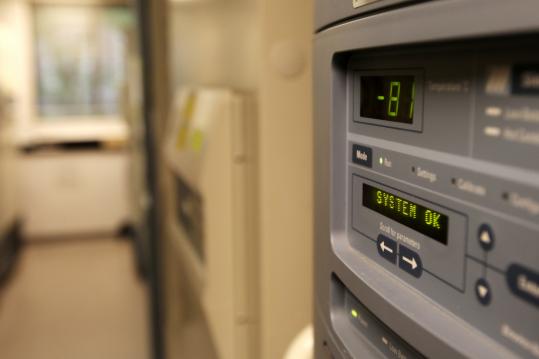
One freezer contained about 150 brain samples from people who had died with a neurological or psychiatric condition.One freezer contained about 150 brain samples from people who had died with a neurological or psychiatric condition. (Photos by Essdras M Suarez/Globe Staff)
By Karen Weintraub
Globe Correspondent / June 11, 2012
Text size – +
A freezer malfunction at Harvard-affiliated McLean Hospital has severely damaged one-third of the world’s largest collection of autism brain samples, potentially setting back research on the disorder by years, scientists say.
An official at the renowned brain bank in Belmont discovered that the freezer had shut down in late May, without triggering two alarms. Inside, they found 150 thawed brains that had turned dark from decay; about a third of them were part of a collection of autism brains.
“This was a priceless collection,’’ said Dr. Francine Benes, director of the Harvard Brain Tissue Resource Center, where the brains were housed. “You can’t express its value in dollar amounts,’’ said Benes, who is leading one of two internal investigations into the freezer failure.
The damage to these brains could slow autism research by a decade as the collection is restored, said Carlos Pardo, a neuropathologist and associate professor of neurology at Johns Hopkins University.
The collection, owned by the advocacy and research organization Autism Speaks, “yields very, very important information that allows us to have a better understanding of what autism is, as well as the contribution of environmental and immune factors,’’ said Pardo, whose 2004 study of brains stored in the bank was the first to find that autism involves the immune system. “The benefit has been great.’’
With that understanding, more effective treatment or prevention becomes possible.
The McLean freezer, one of 24 in the Harvard Brain Tissue Resource Center, was protected by two separate alarm systems, and staff checked an external thermostat twice a day to ensure that the tissue samples were maintained at about minus-80 degrees Celsius. But on May 31, center Assistant Director George Tejada opened so-called Freezer U and wasn’t greeted by the expected blast of cold air. Though the alarms had not been triggered and the external thermostat read minus-79, the actual temperature was 7 degrees, roughly equivalent to a refrigerator. Based on the condition of the brains, Benes estimates the freezer had turned off three days earlier.
Benes said the situation is so unusual - the perfect storm of alarm and thermostat failure and the concentration of samples - that she cannot rule out foul play. She said she has not spoken to law enforcement officials, pending the completion of the internal investigation.
In the interim, she said, McLean will upgrade security in the freezer room, which is under lock and key and watched by a surveillance camera.
The freezer contained about 150 brain samples from people who had died with a neurological condition such as autism, Parkinson’s disease, or Alzheimer’s disease, or a psychiatric one like bipolar disorder or schizophrenia.
More than 50 of those brains made up one-third of Autism Speaks’ Autism Tissue Program, a repository of postmortem brain tissue from children and young adults with the condition. The next largest autism brain bank, at the University of Maryland, has about 60 autism brains, according to its website.Continued...
Page 2 of 2 --
For at least 32 of the more than 50 damaged brains, the tissue had been divided, with half placed in the freezers and the other half placed in formalin, a preservative similar to one used in grade school dissection classes. The preserved halves of the brains remain, Benes said, but they yield different information than the frozen ones.
The defrosted tissue may still be useful for genetics research, said Benes, who is leading an investigation into the quality of the remaining tissue. The DNA, the strands of chemicals that make up the genes, should be OK, she said. But other molecules, including proteins, are probably heavily damaged.
Environmental and other factors can change the proteins produced by the genes, and it is these changes that autism researchers are eager to study, Pardo said.
Autism Speaks is conducting an assessment of the viability of the specimens for continued research. The Autism Tissue Program’s website lists 100 research papers published in peer-reviewed scientific journals based on these donated brains.
Although it is estimated that 1 in 88 children in America have autism, little is known about its cause and what occurs in the brain to produce its characteristic communication difficulties, social challenges, and repetitive behaviors.
The Harvard brain bank has been accepting donated brains of people with autism for about two decades, so it probably will take years to rebuild the collection.
Normally, the brains in the Autism Tissue Program’s collection are equally distributed among the freezers, but had been concentrated in Freezer U in late April to allow program researchers easy access to the samples, Benes said.
After that research was done, staff members were busy with other work and hadn’t had time to return the samples to other freezers, she said. “It was earmarked to be redistributed to sites in various other freezers [soon].’’
Tissue bank staff members do not routinely open the freezers to check internal temperatures, because doing so stresses the $12,000 units and exposes the samples to warmer air.
The Harvard Brain Tissue Resource Center is the nation’s largest and oldest federally funded brain bank and has been storing brains for research for more than 35 years. In addition to neurological and psychiatric conditions, the bank also includes brains from people without any known brain problems to use for comparison. The bank has set up a toll-free number for people who are concerned about samples: 1-877-733-4634. To donate a brain, call 1-800-272-4622.
Pardo said he does not blame McLean. Most researchers have their own freezer horror stories, he said, citing his own five years ago.
“I don’t believe this is human error. I think this is just one of those glitches that sometimes happen,’’ he said.
This incident should be a call to action for other storage facilities and the federal government to pay more attention to freezer safety for the sake of science and donor families, said Stephen W. Scherer, director of the McLaughlin Centre for Molecular Medicine at the University of Toronto and a senior scientist at The Hospital for Sick Children in Toronto.
“The donors, they should be upset, they should realize that this shouldn’t happen, but this shouldn’t dissuade people from continuing to donate, because it is the most important resource that autism science has right now,’’ said Scherer, who has done genetic analyses of brains in the bank.
“If this was to push people from donating going forward, that’s the only thing that would [make this] a worse disaster.’’
Christopher LePoer of Westborough said the damage made him even more grateful to have donated his son Alexei’s brain to the collection, after the 4-year-old snuck out of the house last month and was discovered in a nearby swimming pool. Alexei’s brain was not damaged by the freezer failure, said Benes, who notified the family about the failure on Friday. Because it came in so recently, it had been stored in another freezer.
Christopher LePoer, who has six other children, none of whom has autism, said he was shocked and touched that his son’s brain was now one of those remaining in the brain bank, and therefore even more important to research.
Alexei didn’t speak other than to parrot what others had already said, LePoer said, but he always had a smile on his face. “I just keep thinking about the research and hopefully the information that they can get from him.’’
Karen Weintraub can be reached at Karen@KarenWeintraub.com.